Algonquian Tribes | Climate | Communities | First Nations | History | Home | Metis | Reservations | Sitemap | Tribes


Free Verizon Cell Phone


Nez Perce Indians


There are two Nez Perce Tribes. One is non Algonquian, while the other is Anishinabe. Their original homeland was located in the Montana-Wyoming region, and also included land in the Great Basin of the western United States, which includes Idaho and Oregon, and also in the Washington region. Around 1,000 to 1,300 years ago, prophecy driven Anishinabe soldiers forced their way towards the west from the Great Lakes region and brought nearly all of western North America under their control. They subjugated the native tribes of that region. One of those native tribes were the Nez Perce. Their language is classified as belonging to the Sahaptian Language family.


When the first whites (they were possibly Spanish) appeared in Nez Perce country, they eventually learned that two different peoples existed. One were the Anishinabe subjugators, while the other were Nez Perce who were being subjugated by the powerful Anishinabe Nation. That occurred in possibly the 17th century. White historians recorded that a large group of Shoshone left their homes in the Montana-Wyoming region, and forced their way to the New Mexico, Oklahoma, and Texas region. They did so to battle the white (Spanish) invaders. They eventually brought the Arizona, New Mexico, and Texas region back under Anishinabe control, and then they brought Mexico back under Anishinabe control by 1820. After the whites invented the revolver they wasted little time putting the new weapon to use against the Anishinabe Nation. The whites forced their way in to the east of Texas by 1836. By the 1850s, the whites had forced their way in to the California, Oregon, and Washington region and were commencing their invasion in to the country of the Nez Perce. That be the Oregon and Washington region.


In the early 1850s, the United States was deliberately causing trouble in Indian Territory (that was located in the present day Colorado, Kansas, and Oklahoma region) and it escalated into the so called 1861-1865 American Civil War. In the late 1840s up to the late 1860s, the whites fought a series of wars against the Anishinabe Nation located in the Great Basin and up in the Montana-Oregon-Washington-Wyoming region. Once the whites became acquainted with the Great Basin region, they quickly grew to dislike the region and after the wars ended they thought it their best interest to set aside the entire Great Basin to be a huge Reservation for the Anishinabe Nation and their allies. Idaho, Montana, parts of Oregon and Washington, and Wyoming were included in that huge Reservation, as was western South Dakota. When these wars were being fought, the United States actively sought to form alliances with the Nez Perce who were being subjugated by the Anishinabe Nation. Some of the Nez Perce obviously joined the whites to help the whites destroy Native American Nations. It was not only the Nez Perce the whites sought to form alliances with but also other Indian peoples including the Salish peoples. Many of them joined with white soldiers to help the whites destroy Native American Nations (themselves).


After the last wars (the 1876-1877 Black Hills War and Nez Perce War, and the 1878 Ute War, and 1879 Sheepeater War - Anishinabe people must remember that there are two Nez Perce Tribes, with one being Anishinabe and the other Sahaptian) ended, peace came but the whites refused to honor treaty agreements with the Anishinabe Nation. During the 1877 Nez Perce War, the United States and their Nez Perce allies, deliberately launched military campaigns against the Anishinabe people who lived in the Idaho, Montana, Oregon, and Washington region in order to force them to relocate to nearby Reservations. One was the Nez Perce Reservation of Idaho. They refer to one group of Nez Perce as being non treaty Indians (the Anishinabe people of course) and the other treaty Indians who were the Nez Perce. Anishinabe ogimak continued to honor earlier treaty agreements but the whites broke the treaty promises. That is all that needs to be known. White, Bannock, Crow, Nez Perce, and Shoshone soldiers, launched raids on Anishinabe settlements in 1876 and early 1877. It was a part of the United States 1876-1877 summer and winter military expedition against the Anishinabe Nation of the Idaho, Montana, Oregon, and Washington region. Before this war commenced, the United States attempted to peacefully force the Anishinabe people living freely in the Idaho, Montana, Oregon, and Washington region, to relocate to Reservations. Anishinabe ogimak were aware of the evil white intentions (it is clearly written in the Seven Fires Prophecy that the whites wanted to destroy Native Americans) and nearly all Anishinabek unanimously agreed to fight the whites instead of doing a Nez Perce.


Moses

Moses was obviously an important Anishinabe ogima. White historians claim he was Sinkiuse-Columbia but all evidence indicates he was Anishinabe. Moses was born in 1829 or around the same time ogima Little Shell or Es-ses was born. Moses was from an Anishinabe family which was possibly from their military and police totem. He inherited his fathers power and was fond of war. During the wars between the Anishinabe Nation and the whites in British Columbia, Oregon, Washington, in the 1850s and 1860s, Moses led many Anishinabe soldiers to battle the white invaders. The United States refused to honor the treaty they signed with the Anishinabe Nation which involved land in southern and north central Washington. Instead the United States signed treaty agreements with non Anishinabe Indian Nations in which they ceded Anishinabe land to the United States. It was a clear violation of the treaty agreement between the Anishinabe Nation and the United States. I'm referring to the June 9, 1855 Stevens Treaty which is fraudulent. Moses was a man who loved to venture into Montana (he was from Montana) to hunt buffalo and visit what is now the Great Falls, Montana region which was probably the capital of the Anishinabe Nation at the time.


Those wars which were fought in the British Columbia, Oregon, and Washington region were the same conflict. As in many other cases the whites used the discovery of gold (the excrement of the cowardly gods) and other metals, to entice whites to invade that region, especially in British Columbia. The 1858 war in British Columbia (the Fraser Canyon War) was a part of the Yakima War. And the other wars fought in British Columbia in the 1860s (the 1863 Lalmacha War; 1864 Chilcotin War; the 1860s Fisherville, Tobacco Plains, and Rossland Wars) were an extension of the Snake River War being fought in the Idaho and Montana region. The whites had already forced their way into the Oregon and Washington region by 1860 and were expanding into British Columbia in the 1860s. White soldiers had established many forts in northern Alberta, northern British Columbia, and the Northwest Territories starting in the late 18th century. They used plague warfare to decimate the Indian population in that region. They knew Anishinabe ogimak would try and resume contact with the Anishinabe people in Siberia or eastern Asia. Moses was very likely one of the principle Anishinabe ogimak in the British Columbia, Idaho, Montana, Oregon, and Washington region during these wars fought in the 1850s and 1860s.


Moses took part in the 1876-1877 war but his role was very likely limited to helping those Anishinabe people living in the Idaho, Montana, Oregon, and Washington region commence the exodus. Most Anishinabe ogimak including Moses, felt it important to flee to the British Columbia, Oregon, and Washington region at the time because the whites had already established many settlements including forts there, but their population was still small at the time. British Columbia and Washington, especially British Columbia, was the main location they chose to flee to. Ogima Moses is very important to the present day Anishinabek because through him is evidence that the Anishinabe Nation did not cede their land in Washington. Of course, i am referring to the June 9, 1855 Stevens Treaty. That treaty is fraudulent. The United States was still negotiating with Moses in 1877, 1878, 1879 (these years are very important to Anishinabe people) about the June 9, 1855 treaty. He never ceded that land.


And Moses may have been the more instrumental Anishinabe ogimak during the 1877 Anishinabe exodus out of Montana to the British Columbia and Washington region. That event is known as the 1877 Nez Perce War. After reaching British Columbia and Washington in 1877, he continued to live in British Columbia and Washington with the Anishinabek who were native to that location and fled there in 1877. They were forced to relocate first to the Columbia Reservation then to the Colville Reservation. White settlers could not control their greed and their leaders were just as corrupted. They eradicated the Columbia Reservation simply because of greed.


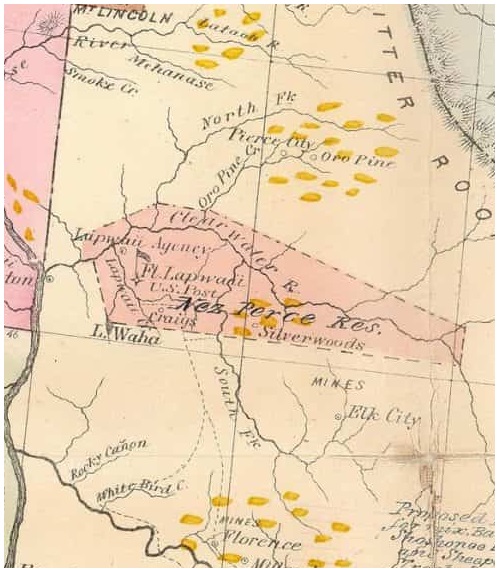
Once the fleeing Anishinabek reached the Grangeville, Idaho region from Montana, they set in motion the first events of this war of defiance. Anishinabe soldiers were instructed to commence to killing the white settlers living on, and south of the Idaho Nez Perce Reservation. That occurred on June 15 and 16, of 1877. In two days Anishinabe soldiers killed around 22 white settlers and wounded many more. After the whites learned of the killings they commenced to flee to the nearest forts for protection. Anishinabe ogimak knew American and Nez Perce soldiers were preparing to wage war on them. Their first target was an Anishinabe settlement (also a camp) located near where present day White Bird, Idaho is, on June 17, 1877. It is known as the Battle of White Bird Canyon. Anishinabe soldiers laid a beating on the American and Nez Perce soldiers. They killed 34 American soldiers and wounded several others. The whites were going to retaliate against the innocent Nez Perce Indians living on the Nez Perce Reservation north of Grangeville, Idaho.


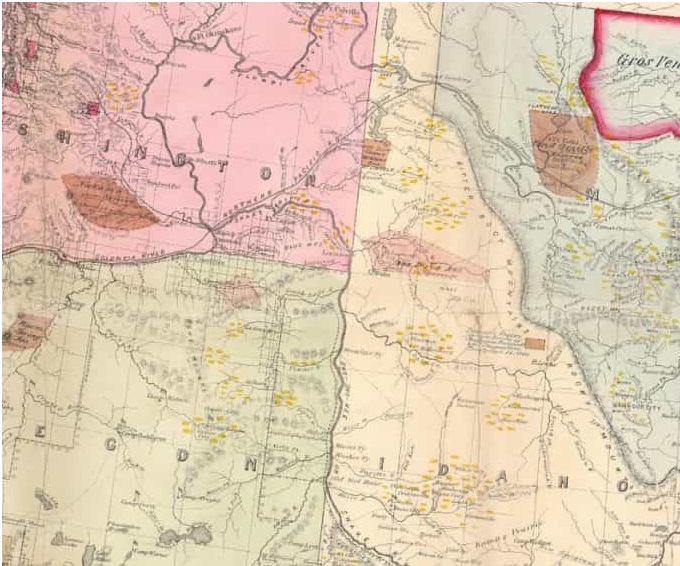
A force of American soldiers marched to the home of chief Looking Glass on the Nez Perce Reservation then attacked his small village. Between 5 and 10 Nez Perce were killed and wounded. Throughout that region of Idaho and northeastern Oregon and southeastern Washington, is a rugged mountainous terrain where 1,000s of Anishinabek lived after the wars ended in 1859 in that area. Supposedly a Reservation was set aside for the Anishinabe Nation in that region but the whites broke treaty promises. It was located just south of Pomeroy, Washington, extends to Pendleton, Oregon and Halfway, Oregon, and over to Council, Idaho, then Cascade, Idaho, then up to Grangeville, Idaho and to the north, then to the Montana border. In fact, the mountainous terrain of that region continues on all the way to the Bitterroot Valley and Big Hole Basin of Montana. It is very mountainous and has very narrow mountain valleys. The further east one goes the higher the mountains become.


After the Battle of White Bird Canyon, more Anishinabek on the run, fled from their Montana homes up to near where Grangeville, Idaho is. Many used the old Anishinabe road which leads from the Great Lakes to the area in Montana where the Missouri River enters Montana and follows the same said river to Fort Benton, Great Falls, and then Cascade where, before enterring the Mountains it split in two directions. One direction of the road went into the mountains to near Canyon Creek, Montana and then turned towards Helena and also towards the Garrison, Montana region. The other direction went westwards towards Augusta, Montana. Before reaching Augusta the road made a turn towards the mountains then enterred the mountain pass and continued on to where present day Lincoln, Montana is. The fleeing Anishinabek most likely used the roads going to Garrison and Lincoln, especially the road which went from Canyon Creek to Garrison.


They probably fled towards the south towards the Salmon River of Idaho, after they reached the Garrison, Montana region and continued on with their exodus. They knew the whites had Indian allies (they were Bannock, Nez Perce, and Salish) and wanted to avoid an unfortunate event. The Americans and their Indian allies, obviously attacked other Anishinabe settlements throughout the Montana region which forced many to surrender. However, many fled from their Montana homes and as with the others, used the Salmon River to reach Oregon and Washington, and joined the other Anishinabek near the Grangeville, Idaho region and then commenced to launch more raids on the white settlers located near Grangeville and to the north and south. Another battle was fought nearly a month later near Grangeville, Idaho. It is known as the Battle of the Clearwater, after more Anishinabek from Montana, Wyoming, and possibly South Dakota reached that area. Some of the Anishinabek did use the old Anishinabe road (the Mullan road) to flee towards the Lolo Pass west of Missoula. They then continued the exodus to Washington by using the Lolo Trail which is an extension of the old Anishinabe road built about 1,000 to 1,300 years ago, as a result of the Seven Fires Prophecy.


More Anishinabe people left the Montana, Wyoming, and possibly South Dakota region as this event progressed on. Many were led by ogima Joseph (better known as Chief Joseph). They reached the western Montana region where the whites and their Bannock, Crow, and Salish allies, were already making plans on attacking them. They possibly followed the Mullan road to western Montana but in all likelihood they followed the Canyon Creek road to the Big Hole Basin. There was probably an Anishinabe settlement in the Big Hole Basin at the time and they were allowed refuge there.


In August of 1877, the United States and their Indian allies (Bannock, Crow, Nez Perce, and Salish) attacked that Anishinabe settlement (camp possibly) in the Big Hole Basin. It is known as the Battle of Big Hole. They may have even planned on attacking the Anishinabe settlements in the Bitterroot Valley and Lemhi Valley, but ogimak Charlo and Tendoy agreed to stay nuetral, or even help the whites. Just after the Battle of Big Hole, the United States and their Indian allies (Anishinabe people must remember they were Bannocks and possibly Crow) attacked either a peaceful Anishinabe settlement or an Anishinabe camp, located around 7 miles south of the Montana border, near Kilgore, Idaho.


It may have been the location of another civilized Anishinabe settlement. The region where the Battle of Camas Creek was fought is almost identical to the Big Hole Basin region of Montana. Both locations have nearly the same elevation which is over 6,000 feet above sea level. However, before the whites and their Indian allies could launch their planned assault on the Anishinabe settlement or camp, a force of brave Anishinabe soldiers met and battled them. It gave the settlements inhabitants enough time to flee to the north. Probably towards the Salmon River. Not long after the Battle of Camas Creek, the whites and their Indian allies (Anishinabe people must remember they were Bannock and Crow) attacked either a peaceful Anishinabe civilized settlement or an Anishinabe camp, a few miles northeast of Laurel, Montana, which is a few miles west of Billings, Montana. It is known as the Battle of Canyon Creek. However, there is that other Canyon Creek, Montana which is located about 15 miles northwest of Helena, Montana. It would seem appropriate to claim the Canyon Creek, Montana where the Battle of Canyon Creek was fought, was located just northwest of Helena, Montana. Before the Battle of Canyon Creek, the Americans and their Indian allies launched a campaign in the Yellowstone National Park region which drove the Anishinabe people living there out. They either fled towards the west or up towards the Salmon River.


Few casualties occurred and most likely the Anishinabe people living in Yellowstone National Park, fled to the Wind River Reservation, or north towards the Upper Yellowstone Valley (more properly known as Paradise Valley of Montana) just north of Mammoth, Wyoming and Gardiner, Montana. After reaching the Paradise Valley of Montana, they simply traveled up to what is now the Livingston, Montana region then up to what is now the Great Falls, Montana region which is 170 miles directly north of Yellowstone National Park. To the east and northeast of Yellowstone National Park, are very tall mountains which would have prevented the fleeing Anishinabek from attempting to cross them. Historians actually claim they fled up to the Laurel, Montana region and then fought the Battle of Canyon Creek, after the events occurred in Yellowstone National Park. Anishinabe scouts learned of the approaching white and Indian soldiers and gathered their women and children and led them out of the Anishinabe town or camp. Then the towns or camps Anishinabe soldiers went out to battle their white and Indian enemies. They successfully prevented the whites from capturing them. They either then fled towards the north or west to the Big Hole Basin or Lolo Pass. If the Battle of Canyon Creek occurred near Helena which it did, the fleeing Anishinabek fled up through the Wolf Creek, Montana region then followed the Missouri River to what is now the Great Falls, Montana region, if they fled towards the north.


An obvious large group of Anishinabek remained on the plains of Montana because of the Battle of Bear Paw. Those Anishinabe people who lived at what is now Great Falls, Montana, fled north to the region just south of the Bear Paw Mountains where they merged with the Anishinabe people from elsewhere in Montana who had no choice but to flee to northern Montana. In September of 1877, the Americans and their Indian allies (the Bannock and Crow) attacked an Anishinabe settlement near Cow Island, Montana. Historians claim the Indians attacked a white trading post, which could be correct, but it was the Americans who were the instigators of this war. Then the Americans and their Indian allies attacked another Anishinabe settlement near Cow Creek, Montana which is north of Cow Island, Montana. Few casualties occurred in those two battles. Then the last battle of this war was fought a few miles south of what is now the Chinook, Montana region. It is known as the Battle of Bear Paw. It lasted 5 days, which gave the Anishinabe people concentrated there enough time to flee up to Canada (Alberta and Saskatchewan). They claim less than 200 Anishinabek led by ogima Joseph reached Canada but in fact the number was much higher. Those other Anishinabe people (the ones who refused to fight) who lived in the Bitterroot Valley and Lemhi Valley and other locations such as in southwestern Montana and on the plains of Montana, obviously stayed nuetral in this war. Today, they are known as the Little Shell Tribe of Chippewa Indians of Montana.


During the previous winter and in 1876, the Americans first concentrated their war effort on the Anishinabe people living in eastern Montana, eastern Wyoming, and northwestern South Dakota, excepting the January 23, 1877 Marias River Massacre which actually occurred at what is now the Great Falls, Montana region. Historians claim the Americans massacred the Anishinabek at the Marias River Massacre to avenge the death of a white man (Custer) the previous year. Then came the summer of 1877 and the Americans deliberate military onslaught against the Anishinabe people who lived in Montana, Wyoming, western South Dakota, southeastern Washington, northeastern Oregion, and northern Idaho. Ogima Joseph described exactly how the whites stole Anishinabe land. He said a white man came to him and asked to buy his land. Ogima Joseph said no. Then the white man went to a neighboring tribe and told them he would sell Ogima Josephs land to them (have them buy Indian land). Then the white man returned to ogima Joseph and told him he just bought (it was actually the Indian allies of the whites who bought the Anishinabe land) his land and he had to give it to him.


After the last battles of this war were fought, the United States created the filthy 1887 Dawes Act which was created specifically to eradicate the Promised Land, or the huge Reservation the United States set aside in the Great Basin region and in the Idaho, Montana, Wyoming, western South Dakota and Washington region. Afterwards, many much smaller Reservations were set aside for the Anishinabek and the Bannock, Nez Perce, Paiute, Utes, other Sahaptians, and the Salish. All Reservations established before 1887 throughout that entire region, were established for the Sahaptians, Paiutes, and Utes. All Reservations established in the western United States in 1887 and after 1887, are Anishinabe Reservations. They were established for small groups of Anishinabe people who followed the Seven Fires Prophecy and fled towards the west. Most ended up in California. Below is a list of the Nez Perce Reservations which were established before 1887. Today, the Nez Perce have no choice but to regret the actions of their obnoxious ancestors.


One is the Flathead Reservation of Montana. In 1871 or 1872, chief Arlee led a group of Nez Perce (they may have been Anishinabe for all we know) from the Bitterroot Valley (they were kicked out by the whites) up to the Flathead Reservation, where they settled primarily where the town of Arlee is located. They have been forced by the whites to lose their nationality. Ogima Charlo and the Anishinabe people he led, continued to live in the Bitterroot Valley for another 20 years before the whites forced them to relocate to the Flathead Reservation in October of 1891. They are still clinging on to their Anishinabe identity on the Flathead Reservation. Ogima Joseph and some of the remaining Anishinabek in Idaho, Montana, Oregon, and Washington, were relocated to Oklahoma where they lived for nearly a decade. Through negotiations, ogima Joseph persuaded the United States to allow him and his subjects, to return to their original homeland in 1885. That be the same year ogima Little Bear fought in the 1885 Northwest Rebellion and fled back to his native homeland which is Montana.


They were allowed to return to the Nez Perce Reservation but according to historians the whites who lived near and on the Reservation, did not want the Anishinabek returning so they moved to the Colville Reservation instead and were forced to lose their nationality. Ogima Joseph did not want anything to do with the Nez Perce Indians. He obviously hated them for siding with the evil white race. The same can be said for ogima Charlo. Ogima Charlo said he rather relocate to the plains of Montana then live with the Kootenai, Nez Perce (if any Nez Perce lived on the Flathead Reservation), and Salish peoples of the Flathead Reservation. Unfortunately, ogima Charlo had no choice but to relocate to the Flathead Reservation in 1891. Ogima Tendoy died in 1907 and the supposed Lemhi Reservation was eradicated soon afterwards. Anishinabe men led their woman and children off the Lemhi Reservation and commenced an exodus towards Nevada and California. Some probably settled down to live on the Fort Hall Reservation.


Lapwai Reservation in Idaho

It covers 1,203 sq. mi., or 770,453 acres (only 108,534 acres is owned by Indians).
Population is 17,559 (nearly all are non Indian).
Language is Sahaptian

Colville Reservation in Washington

It covers 2,117 sq. mi. (most, over 1,100,000 acres is owned by Indians - the Nez Perce on this Reservation are Anishinabe).
Population is 7,587 (two thirds of the population is Indian).
Language is Algonquian-Salish-Wakashan

Flathead Reservation in Montana

It covers 1,938 sq. mi. (most is now owned by Indians - the Nez Perce on this Reservation are probably Anishinabe).
Population is 26,172 (6,999 is Indian).
Language is Algonquian-Salish-Wakashan


Free Book


The Algonquian Conquest of the Mediterranean Region of 11,500 Years Ago


Home | Contact


© 2009-2012 Anishinabe-History.Com