Ojibwa AI Videos ___ Walmart ___ Amazon
Ojibwa Prophesy ____ Ebay ______ TV Playlists
Montana Ojibwe Reservations and their Communities Book
Minnesota Ojibwe Reservations and their Communities Book
Place Names of the Ojibwa in Future Codes Book

Anishinabe History
Ojibwa AI Videos ___ Walmart ___ Amazon
Ojibwa Prophesy ____ Ebay ______ TV Playlists
Montana Ojibwe Reservations and their Communities Book
Minnesota Ojibwe Reservations and their Communities Book
Place Names of the Ojibwa in Future Codes Book
Uintah Valley/Uncompahgre Reservation
This Ojibwa Reservations history is related to that of Confederated Ute Reservation which was created on March 2, 1868. Below are maps of Uintah Valley Reservation and links to google earth photos of Fort Duchesne. Few people know about Confederated Ute Reservation, especially it's location (supposedly nearly all of western Colorado yet probably most of east Utah) and that Hopi Reservation was a land addition to Confederated Ute Reservation. Uintah Valley Reservation was actually created on October 3, 1861. What transpired in 1868, was a vast land addition to Uintah Valley Reservation. They eradicated Confederated Ute Reservation in 1878. Not all of Confederated Ute Reservation however.
Uintah Valley Reservations 1882 land addition (Uncompahgre Reservation)
A large area of worthless land where Uncompahgre Reservation is was either added to Uintah Valley Reservation or diminished from Confederated Ute Reservation. Uncompahgre Reservation was made official on January 5, 1882. Then 15 years later, American leaders used trickery and set aside Uncompahgre Reservation for chief Rocky Boys Ojibwa Subjects. American leaders had schemed to forcefully relocate Ojibwa's from the Great Falls, Montana region as early as the 1860's. The Great Falls, Montana region is capital of Ojibwa People. During the early and mid 19th century, 100,000's of Ojibwa's lived at the Great Falls region or north central Montana. Their population was decimated after American leaders killed off the livestock of Ojibwa People which was mainly buffalo. In 1895, American leaders set in motion land cessions from Reservations to relocate the large Ojibwa population at the Great Falls, Montana region. One of those Reservations is Uncompahgre Reservation. It was given to chief Rocky Boys Ojibwa Subjects on June 7, 1897. In 1897 and after, 100's of chief Rocky Boys Ojibwa Subjects settled Uncompahgre Reservation which continues to be a part of Uintah Valley Reservation. After 1900, American leaders forced Ojibwa's of Uncompahgre Reservation to relocate to Navajo Reservation and it involved some violence. Uncompahgre Reservation remains a part of Uintah Valley Reservation!
President Roosevelt's Proclamations of July 14, 1905 are not to be trusted. They are usually misconstrued. Uintah Valley Reservation was opened to white settlement. An area of land covering 1,004,285 acres was declared Surplus Land and opened to white settlement. It's no longer a part of Uintah Valley Reservation. Land for townsites covering 2,100 acres was set aside. And 2,140 acres was set aside for mining claims. However, their deceit is the 1,010,000 acres set aside to be a National Forest or Protected Land. That 1,010,000 acres belongs to Uintah Valley Reservation. There are two parties involved and we don't have the Ute account of what transpired on July 14, 1905.
At issue is 1,010,000 acres! Ute leaders were definitely very content to have most of their Reservation protected. Their protected land is located at Uintah Valley Reservations north and east. Land was allotted at Uintah Valley Reservations east or from Ouray to Whiterocks. They have several communities in that location including Fort Duchesne, Ouray (it has yet to be developed), Randlett and, of course, Whiterocks. Near Fort Duchesne are possibly 2 communities yet they are considered a part of Fort Duchesne. They could be Ojibwa Enclaves!
Uintah Valley Reservation Land act of May 27, 1902: It allotted 99,407 acres to 1,284 Shoshone Ojibwa citizens of Uintah Valley Reservation. Land allotments were obviously located at Uintah Valley Reservations east portion. Land under reclamation was 60,160 acres. What was left was 1,189,194.65 acres. Of that, 179,194.65 acres was classified as residue land. Chief Rocky Boy reached an agreement with President Roosevelt before May 27, 1902 to protect Uintah Valley Reservations northern mountains. Land adjacent to the northern mountains and south of them by a few miles, remains protected Uintah Valley Reservation land.
Presidents Proclamation of July 14, 1905: A land area of 1,010,000 acres from Uintah Valley Reservation was set aside as protected Reservation land. It became part of a State Forest Reserve then part of a National Forest. Total land area of diminished Uintah Valley Reservation is 1,348,761 acres. These land dealings happened in 1902 and 1905. No land was declared Surplus Land on May 27, 1902. However, on July 14, 1905 they declared 1,004,285 acres Surplus Land and opened it to white settlement. It's the 1,010,000 acres that continues to belong to Uintah Valley Reservation. After these land dealings, Uintah Valley Reservation was left with 1,348,761.65 acres. Many of the Ute land allotments were illegally sold to whites. Chief Rocky Boy agreed to allow land allotments as long as if they were in compact form and could not be sold. Uintah Valley Reservation including Uncompahgre Districts 1.9 million acres, was not eradicated! Uintah Valley Reservations Government has jurisdiction or owns those land allotments. Be them "Trust Land Allotments or Fee Land Allotments." Difference between "Trust Land Allotments and Fee Land Allotments" is taxes. Owners of "Trust Land Allotments" don't have to pay taxes. Owners of "Fee Land Allotments" are subject to City, County, State and Federal taxes.
Fort Duchesne Satellite Image
Fort Duchesne Road View
Fort Duchesne Road View
Fort Duchesne Road View
Fort Duchesne Road View
Fort Duchesne Road View
Fort Duchesne Road View
Fort Duchesne Road View
Fort Duchesne Road View
Fort Duchesne Road View
Fort Duchesne Road View
Fort Duchesne Road View
Fort Duchesne Road View
Fort Duchesne Road View
Fort Duchesne Road View
Fort Duchesne Road View
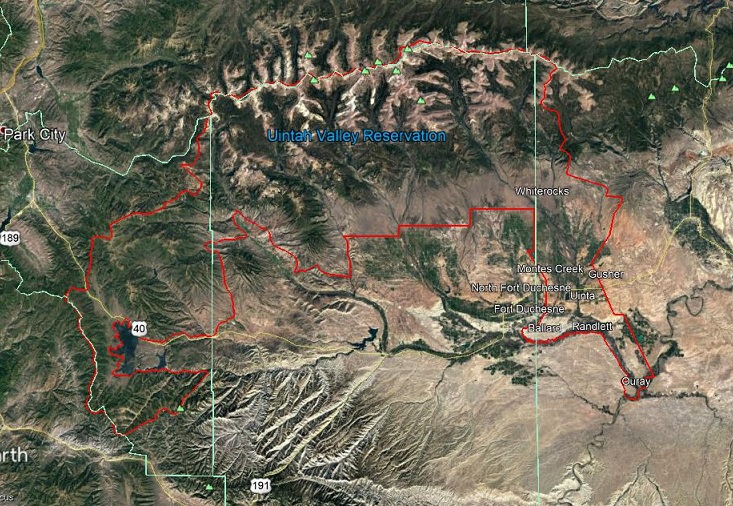
Map does not depict the original boundaries of Uintah Valley Reservation. We actually don't know the correct boundaries of Uintah Valley Reservation after the Surplus Land was ceded on July 14, 1905. Land from Strawberry Reservoir west to Uintah Valley Reservations west boundary and south of Strawberry Reservoir, was Surplus Land. Uintah County's west boundary is an obvious boundary. Land adjacent to and west of Uintah County was ceded. Land extending north to about 4 or 5 miles south of Uintah Valley Reservations mountains was Surplus Land and ceded. However, at the region west, south and southwest of Strawberry Reservoir, the land is protected land or State Forest Land that could continue to be Uintah Valley Reservation land.
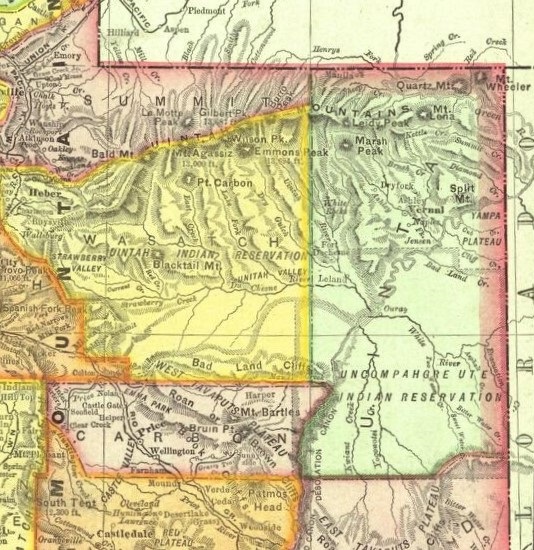
Above map is from 1905. Both Uintah Valley Reservation and Uncompahgre Reservation are included. Uncompahgre District is adjacent to Colorado and is why I suspect Confederated Ute Reservation was located at east Utah and not west Colorado. Uncompahgre District extends several miles west of Uintah County's west boundary. It's extreme south boundary extends east in a straight line to the Colorado Boundary.
Demographics of Uintah Valley/Uncompahgre Reservation
Land Area: 5,076 sq. mi. or 3,248,761 acres - 13,147.3 sq. km. or 1,314,726.9 hectares
Population: Not corectly known because the United States refuses to honor treaty (we don't know the correct boundaries)
Language: Corrupted
