Ojibwa AI Videos ___ Walmart ___ Amazon
Ojibwa Prophesy ____ Ebay ______ TV Playlists
Montana Ojibwe Reservations and their Communities Book
Minnesota Ojibwe Reservations and their Communities Book
Place Names of the Ojibwa in Future Codes Book

Anishinabe History
Ojibwa AI Videos ___ Walmart ___ Amazon
Ojibwa Prophesy ____ Ebay ______ TV Playlists
Montana Ojibwe Reservations and their Communities Book
Minnesota Ojibwe Reservations and their Communities Book
Place Names of the Ojibwa in Future Codes Book
Cote First Nation
This Ojibwa First Nation of Cote Reserve is very near the Manitoba/Saskatchewan border. Below are links to google earth photos of Badgerville which is a Cote town (Mis-sa-ga-kwid-jis O-de-na or Badgertown) and Springside. I don't have any idea what words Ojibwa's use for Springside in Ojibwa Language. Definition of "side" is a boundary, divide, ect. An example is: they'll divide land equally. Ojibwa word for Distribution and Division is difficult to learn of. I'll provide three words Ojibwa's use incorrectly for Distribution and Division. Madaokiwin, Madaodiwin and Nenawitagewin. Madaokiwin means "distribute/divide habitual. Madaodiwin means distribute/divide together. Nenawitagewin means distribute/divide creation. Which one is appropriate for the word "side?" Mada or Nena? This will confuse Ojibwa's who speak Ojibwa Language. Ki-win means habitual. Di-win means together. Ge-win means creation. Mada is the correct word to use for boundary, distribute, divide and side. Ojibwa's use "Sig-waan Ma-da" for Springside. If one want's to learn Ojibwa Language they must use Ojibwa to English. Investigate words last syllables. Most prominent is "win." An Ojibwa word that has "win" as it's last syllable corresponds to Latin. Why? English is a Latin Language. Ojibwa's use "win" to identify with Latin suffixes like "ment, tion, ect." There's also a satellite image of The Key. 2021's census reported Cote Reserve First Nation has an on-Reserve population of 799. They have 288 dwellings with 253 lived in. Average household size is 3.2 persons per household. An estimated 5.6% of the population of Cote First Nation is 70 years of age or older. Around 70 speak Ojibwa Language at Cote First Nation which is located at Saskatchewan. Cote First Nation Reserve was originally within the 19th century Birdtle Ojibwa Reserve. From the Swan River region of Manitoba they were forced to migrate to where they now live! History of Cote First Nation includes Yellow Quill who was from the Swan Lake and Swan River region of Manitoba which is 36 miles (59 kilometers) northeast of Keeseekoose. Use of trickery and deceptions by white leaders enraged authentic Ojibwa leaders. Yellow Quills power extended over southeast Saskatchewan and the region where Pine Creek First Nation, Wuskwi Sipihk First Nation and Sapotawayak First Nation are located at Manitoba. Yellow Quill was from the Swan River region of Manitoba. He was not an authentic Ojibwa leader. He was employed by HBC (Hudson Bay Company). Below is text of some of their history going back to the 18th century that you must read very carefully.
Satellite Image of Badgerville
Road View 1.
Road View 2.
Road View 3.
Road View 4.
Road View 5.
Road View 6.
Road View 7.
Road View 8.
Road View 9.
Satellite Image of Springside
Road View 1.
Road View 2.
Road View 3.
Road View 4.
Road View 5.
Road View 6.
The Key Satellite Image
Qu'Appelle Agency Ojibwa Reserves
Carry The Kettle, Long Lodge and Poor Man Reserve (Poor Man is also known as Lean Man) - Carry The Kettle Ojibwa Reserve
Muscowpetung/Pasqua Reserve (land additions to Muscowpetung and Pasqua include Piaot and Standing Buffalo) - Muscowpetung Ojibwa Reserve
Little Black Bear, Okanese, Peepeekisis and Star Blanket Reserve - File Hills Ojibwa Reserve
Chacachas, Cowesses, Kahkewistahaw, Ochapowace, O'Soup, Ouchaness and Sakimay Reserve - Crooked Lakes Ojibwa Reserve
Keeseekoose, Key, "Phesant Rump, Red Ears," Waywayseecappo and "White Bear" Reserve (this is the original extensive Ojibwa Reserve Cote was within) - Yellow Quill Ojibwa Reserve
Day Star, Gordon, Muscowequan, Nut Lake and Poor Man Reserve (Fishing Lake, Kinistin and Yellow Quill are a part of Nut Lake) - Touchwood Hills Ojibwa Reserve
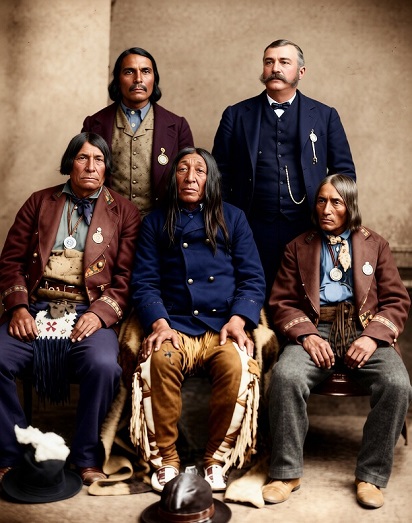
From left to right on bottom row sitting are Ahtahkakoop (aka Star Blanket), Kahkewistahaw and Mistawasis. Standing behind them from left to right are O'Soup and Peter Hourie (aka Yellow Quill).
Peter Hourie was a mixed blood who was born at Red River Colony in 1825 or 1827. In 1849 he became a Middleman (middle position in a canoe) at Swan River, Manitoba where he remained until 1864. Hourie convinced Ojibwa leaders to allow a trade post to be built where Fort Qu'Appelle is. From Swan River he became well known throughout south Saskatchewan and southwest Manitoba. At Swan River he held Post Master (he managed the trade post) position at Swan River "Trade Post." After the HBC Trade Post was completed at Qu'Appelle, Hourie became Post Master of Qu'Appelle Trade Post which was eventually upgraded to a fort. An early account of Peter Hourie at beautiful Qu'Appelle River Valley (it's located on the plains of south Saskatchewan) describe Hourie and his employees or friends, camped near Qu'Appelle River and watching incredible numbers of buffalo enter the river to reach the other side then climb up the small hills to reach the plains. It went on for 24 hours according to Hourie and the number of buffalo was estimated at one million. That's at one location! Hourie and his companions were devastated after the buffalo were killed off about 20 years later. So there's a connection from Swan River, Manitoba and Fort Qu'Appelle which is 142 miles (229 kilometers) southeast of Swan River, Manitoba. In 1866 he left HBC (aka Hudson Bay Company) to do business on his own. In 1874 he was hired by Canada as a special agent to encourage Ojibwa's of southeast Saskatchewan and southwest Manitoba to consider treaties. During 1885's Northwest Rebellion he served as Chief Scout and interpreter for General Middleton. Hourie was Yellow Quill. Treaty 4 was his responsibility. No authentic Ojibwa leader would sign a treaty with one person or one family. None of the men in the above photo were authentic Ojibwa leaders. All appear to wear small medallions except Kahkewistahaw, which indicates they were employed by white leaders. Kahkewistahaw was probably from Montana. It's known he lived at the Cypress Hills where 10,000 or more Montana Ojibwa's fled to during 1876/1877's War. Hourie was well known from Swan River to all Ojibwa Reserves at southeast Saskatchewan including Qu'Appelle Lakes Ojibwa Reserve, Crooked Lakes Ojibwa Reserve, File Hills Ojibwa Reserve, Touchwood Hills Ojibwa Reserve and Carry The Kettle Ojibwa Reserve. Hourie also convinced Montana Ojibwa leaders and their Montana Ojibwa Subjects who fled to the Cypress Hills to relocate to the Ojibwa Reserves previously written.
All Qu'Appelle Agency Ojibwa Reserves continued to be managed by Qu'Appelle Agency until 1885 except Yellow Quill Ojibwa Reserve. That's probably because of Yellow Quill who considered Swan River at Manitoba his native home. He lived there a long time. A serious incident took place there that led to many Ojibwa's relocating southwest to where Cote, Keeseekoose, The Key, Valley River and Yellow Quill are located at at Saskatchewan. It was probably 1885's Northwest Rebellion. Many Ojibwa's fled north to where Lac La Ronge, Montreal Lake and Peter Ballantyne are located. However, not all Ojibwa's left the Swan River region of Manitoba. Pine Creek, Sapotaweyak and Wuskwi Sipihk are their Ojibwa descendents. Yellow Quill had power over all Treaty 4 Ojibwa Reserves of southeast Saskatchewan and southwest Manitoba. They include:
MANITOBA
Gamblers
Pine Creek
Rolling River
Valley River (aka Tootinaowaziibeeng)
Waywayseecappo
SASKATCHEWAN
Carry The Kettle
Cote
Cowesses (probably many Montana Ojibwa refugees)
Day Star
Fishing Lake
Gordon
Kahkewistahaw (probably many Montana Ojibwa refugees)
Kawacatoose (aka Lean Man)
Keeseekoose
Kinistin
Little Black Bear
Muskowekwan
Muscowpetung
Nekaneet (greatly reduced Cypress Hills Ojibwa Reserve)
Ocean Man
Ochapowace
Okanese
Pasqua
Peepeekisis
Pheasant Rump
Piapot (probably many Montana Ojibwa refugees)
Standing Buffalo (probably many Montana Ojibwa refugees)
Star Blanket (there are two Star Blanket Reserves - Ahtahkakoop and one at File Hills Ojibwa Reserve)
The Key
Whitebear
Zagime
Other Ojibwa's included with Treaty 4 include Keeseekoowenin (with Waywayseecappo), Wood Mountain (with Nekaneet) and Sapotaweyak and Wuskwi Sipihk with Yellow Quill Ojibwa's. Yellow Quill remained active with the Ojibwa Reserves he had created illegally. Swan River was possibly his favorite yet Crooked Lakes, Qu'Appelle Lakes and Touchwood Hills Reserves became his concern after Treaty 4. After reaching his 80's he made decision to relocate to Regina where he made his departure. No one knows about the real Yellow Quill. Anyone familiar with First Nations have a belief that Swan Lake First Nation (it's located at extreme south Manitoba) was where Yellow Quill lived and died. There's a Swan Lake near Swan River, Manitoba you must consider. Also, there's Yellow Quill Ojibwa's of Saskatchewan who include Fishing Lake and Kinistin. And Nut Lake (Yellow Quills Ojibwa's) is located where Punnichy, Saskatchewan is. During the late 1860's Yellow Quill prevented greedy Louis Riel and his other greedy white friends from expanding west of Red River Colony. England appreciated Yellow Quills actions which led to treaties. Louis Riel was a greedy white trouble maker. He was executed for instigating 1885's Northwest Rebellion. Riel and his other greedy white friends wanted to colonize vast Ojibwa Reserves and the Celtic, Dutch and Italian (Metis or mixed people) Colony located along each side of South Saskatchewan River at Saskatchewan.
At southwest Manitoba there are Waywayseecappo Ojibwa's who also include Gambler's, Keeseekoowenin and Rolling River. On June 9, 1886 Moose Mountain Ojibwa Reserve was created and includes Pheasant Rump, Red Ears and White Bear. So as you know a serious incident led to many Ojibwa's forcing their way north. How extensive was Yellow Quill Ojibwa Reserve? From Riding Mountain National Park Region of southwest Manitoba then up to Duck Mountain Provincial Park Region of Manitoba then extended northwest to where Yellow Quill is located at Saskatchewan then directly east to Lake Winnipegosis at Manitoba. Most of the extensive Ojibwa Reserve was heavily forested. There's reason to reverse what historians wrote. Pheasant Rump, Red Ears and White bear were never a part of Keeseekoose and Key. Cote is! Why they refused to include Cote deals with much of Yellow Quill Reserve extending to Manitoba. One thing is for certain! We know Cote is involved and land at Manitoba where Swan River is is also involved. We must include Waywayseecappo Ojibwa's including Keeseekoowenin and Rolling River. During 1880's, Yellow Quill Ojibwa Reserve was heavily forested with 1,000's of Ojibwa's living throughout their extensive Reserve. Their communities include Cote, Fishing Lake, Keeseekoose, Keeseekoowenin, Kinistin, Pine Creek, Sapotaweyak, Valley River, Waywayseecappo, Wuskwi Sipihk and Yellow Quill.
In 1889, Cote, Keeseekoose and Key were transferred to Pelly Agency. In 1904, a decision was made to transfer Valley River to Pelly Agency and it was because of land surrenders to Montana Ojibwa's. It indicates Montana Ojibwa's were relocated to Valley River in 1904 and 1905. We've been told to find evidence along a trail by prophesy. We are following prophesy! Chief Rocky Boy either reached an agreement in 1903 or 1904 to relocate some of his Montana Ojibwa Subjects to Valley River First Nation!
Valley River and Gambler were the same Ojibwa's yet some possibly lived where Gambler First Nation is and others where Valley River is. Birtle Agency started managing Gamblers in 1881. On May 15, 1878 an agent was appointed to manage Birtle Agency Ojibwa Reserves. Four separate Ojibwa Reserves listed above were managed by Birtle Agency. Waywayseecappo was possibly where Birtle Agency was originally located. Even now they have a town at Waywayseecappo named Birtle or Bird Tail. We can trace the fragmentation of Birtle Agency Ojibwa Reserve to 1886 or a year after 1885's Northwest Rebellion. In 1889, Cote (first mention of Cote under an agency management), Keeseekoose and Key transferred to Pelly Agency management. In 1905, Valley River was transferred to Pelly Agency. That's a predicament because of Riding Mountain National Park! We must include Waywayseecappo Ojibwa's with Valley River. Fishing Lake (Yellow Quill Ojibwa's) is listed with Cote, Keeseekoose and Key yet no year was provided for their entrance to agency management. Supposedly in 1907 Fishing Lake (Yellow Quill Ojibwa's) were transferred back to Touchwood Agency. In 1949 Valley River was transferred to Dauphin Agency. It's confusing yet does make sense! At issue is Cote who are from Yellow Quill Ojibwa's of the Swan River region of Manitoba. Canada is concealing an extensive Ojibwa Reserve!
Land Surrenders
The history of Cote includes Keeseekoose and The Key. Originally they were one Reserve and must be considered one Reserve! Between 1897 and 1911, Canada forced some Ojibwa Reserves to surrender land to Montana Ojibwa's led by chief Rocky Boy. American leaders sent American Soldiers to round up 1,000's of Ojibwa's living at their Ojibwa Reservation at the Great Falls and Helena region during summer of 1896. American Soldiers were also sent to Little Bears Fort Assiniboine Indian Reservation (aka Rocky Boys Reservation) during Summer 1896 to round up 100's of Little Bears Ojibwa Subjects and relocate them to Canada. Little Bear and supposedly near 200 of his Ojibwa Subjects were sent to Ohio to participate in wild west shows during summer 1896. After Little Bear was informed American leaders rounded up 100's of his Ojibwa Subjects and relocated them to Canada (Little Bear and his Ojibwa Subjects were natives of Canada) he became despondent. On October 9, 1891 the United States forced Little Bear to cede most of his Ojibwa Reservation. From over 700,000 acres it was reduced to 220,000 acres. In 1896 Little Bear probably didn't know his Ojibwa Subjects living on his Reservations ceded portion would be relocated to Canada. More relocations continued up to 1916.
On June 21, 1904, Cote Ojibwa's were forced to surrender 302.06 acres. A small area of land for a townsite. Canada already reached an agreement with the United States to accept many Montana Ojibwa's. Kamsack now sits on land ceded to Montana Ojibwa's. In 1905, Cote Ojibwa's were forced again to surrender land to Montana Ojibwa's. This time 18,043 acres was surrendered to Montana Ojibwa's. In 1907, more Montana Ojibwa's were forcefully relocated away from Montana. This time 10,740 acres was surrendered by Cote Ojibwa's to Montana Ojibwa's. In 1909, The Key Ojibwa's were forced to surrender 11,500 acres to Montana Ojibwa's led by chief Rocky Boy. Instead of giving the surrendered land to Montana Ojibwa's, Canada betrayed Cote First Nation, The Key First Nation and Montana Ojibwa's and told them to get lost. Over 40,000 acres was ceded to Montana Ojibwa's and Canada refused to honor the agreement. Leaders of Cote First Nation must agree with all Ojibwa leaders of Saskatchewan to petition Canada for a very large Ojibwa Reserve to be created at Saskatchewan. Cree People are really the Athabascan Beaver Tribe. There are no Cree First Nations at Saskatchewan, Manitoba, Ontario and Quebec! Below the photos are excerpts from very old books that will help educate you! Look for the 18th century maps. Instead of south to north they are from southeast to northwest. Churchill River is the north boundary. A few Assiniboine and Cree lived west of Lake Winnipeg but were driven to the northwest by 1800 by Ojibwa Soldiers. Churchill River was a boundary used in the 18th century. From Churchill, Manitoba to South Indian Lake, Manitoba to Sandy Bay, Saskatchewan to Buffalo Narrows, Saskatchewan where the source of Churchill River is, this river flows for 1,000 miles. It's source is Churchill Lake, Saskatchewan. All land north of Churchill River is Chipewyan land. Chipewyan is the correct pronunciation of O Chib-bwan or Chib-bwan which means "The Originals and Originals in Ojibwa Language." Remember that white leaders are suppose to prove to Native Americans that whites are the brothers and sisters of Native Americans!

Look for the mountain peak shape on the map. That's where Churchill is located. Churchill River is almost adjacent to Churchill Town. Part London of Hudson Bay is written above the mountain shaped peak. You can tell it's been violated! It should read "Part of Hudson Bay." Andrew Graham drew the map in 1774. In 1991, another source "Ruggles," either copied the 1774 map of Andrew Graham or changed it. Lake Winnipeg and Lake Manitoba (Mantouabau) look awkward!. That's because the map is from southeast to northwest. Nekawawuck Indian Country represents Northern Ojibwa Territory. It's definition is not known. However, the "ne" represents point in Ojibwa Language so it refers to a place and people. Discovering what "ka-wa-wuck" means won't be easy! Word for "Freezing" in Ojibwa Language is either "Mash-ka-wad-ji-win or Ga-wad-ji-win." The 'd' is not pronounced. It's used to let learners know that the following 'j' is pronounced like judge, just, ect. Not like 'zhi.' Ne Ka-wa-wuck probably means "Point Freeze People." Pronunciation is "Nay Ga-wa-wug." An excellent description of the Churchill, Manitoba region! Of course, you've noticed the point where Churchill is! Keskachewan (Italians and the Beaver Tribe or Cree) Territory extends to almost Nunavut. Dogrib Territory (Ateemouspecky) Territory is located at southwest Nunavut.

This is a satellite image of the same region from google earth. It's from a southeast to northwest direction. It fits in well with the 1774 Andrew Graham Map. Lake Winnipeg looks almost similar to how it's depicted on the 1774 Andrew Graham Map.

What did they mean by "Keskachewans Resort Prior To European Settlements?" Were they indicating the Keskachewans resorted to migrate west. If they did resort to a west migration, Graham was writing about the establishment of Cumberland House at Saskatchewan in 1774. That would confirm the Keskachewans were Europeans with some of the Beaver Tribe (the Assiniboine and Cree) who sneaked their way to what is now the Cumberland House Region of Saskatchewan in 1774. Italians had already reached that area decades earlier! That's why Graham was familiar with that region! If Graham was referring to Italians reaching Manitoba and Saskatchewan in the 1730's and early 1750's that is! Fort de la Corne was built in 1753. It was located east of what is now Prince Albert, Saskatchewan almost adjacent to the east border of James Smith Reserve. Fort La Jonquiere was built in 1751 and was located near what is now Nipawin, Saskatchewan. Italians had established forts at south Manitoba in the 1730's. Using alcohol and drugs they lured in idiotic Ojibwa's (the Beaver Tribe or Assiniboine and Cree) who pitched their camps near the three Italian Forts built at south Manitoba. After Ojibwa Soldiers drove the Italians out during 1750-1763's War, those idiotic Ojibwa's relocated to European Forts adjacent to Hudson Bay. If Keskachewans do represent Europeans it means Northern Ojibwa Territory extends as far north as the Arctic Ocean! Graham wrote "NORTHERN KESKACHEWAN - BEAVER INDIANS." Cursive writing on the maps is very difficult to decipher. Graham was certainly referring to Europeans and idiotic Ojibwa's (the Assiniboine and Cree) as being the KESKACHEWANS AND BEAVER INDIANS. SOUTHERN KESKACHEWANS REPRESENT EUROPEANS OR ITALIAN'S. Evidently Italians continued to live at south Manitoba in the late 18th century. Though Graham wrote Assiniboine as Asenepoets we know who they are. Asenepoets is pronounced 'Ah-sin-ni-poats.' Read the following carefully. At Island Lake, Manitoba, Ojibwa leaders of Garden Hill, St. Theresa Point, Wasagamack and Red Sucker Lake are so stupid they don't know what "Oji" means. It's a combined word meaning "The originals." The "O" means 'the' in Ojibwa Language. Similar in sound to the Ojibwa word for 'that' which is "aw." It's pronounced "ow." It ryhmes with 'cow.' Oji is from "O Tchi Bwa." Word for before as in original in Ojibwa Language is "Tchi Bwa." It's pronounced "Tchib Bwa." Some Ojibwa Language Dialects pronounce it "Ji Bwa or Jib Bwa." They're scared and looking for excuses!


