Ojibwa AI Videos ___ Walmart ___ Amazon
Ojibwa Prophesy ____ Ebay ______ TV Playlists
Montana Ojibwe Reservations and their Communities Book
Minnesota Ojibwe Reservations and their Communities Book
Place Names of the Ojibwa in Future Codes Book

Anishinabe History
Ojibwa AI Videos ___ Walmart ___ Amazon
Ojibwa Prophesy ____ Ebay ______ TV Playlists
Montana Ojibwe Reservations and their Communities Book
Minnesota Ojibwe Reservations and their Communities Book
Place Names of the Ojibwa in Future Codes Book
Fort Peck Reservation
This Reservations location is incorrect. Below are links to google earth photos of Fort Peck Reservation towns and a news article about chief Rocky Boy's Ojibwa Subjects being relocated from Helena, Montana to a location 400 miles from Helena, as well as demographics of this Ojibwa Reserve located at northeast Montana and North Dakota. The Rocky Boy Tribe must bring Fort Peck Reservation, Fort Buford Reservation and Turtle Mountain Reservation and it's land allotments under their control because they belong to the Rocky Boy Tribe. It deals with 1908's Fort Peck Reservations Land Act and forced relocations of chief Rocky Boys Ojibwa Subjects. Fort Peck Reservation has been extremely violated by the evil white race!
Fort Peck Reservation was created by May 1, 1888's Sweetgrass Hills Treaty. Originally located from adjacent to Mississippi River (aka Missouri River) east to the Dakota boundary then up to the Canada/United States border and west to the confluence of Milk River and Mississippi River (aka Missouri River) then north to the Canada/United States border. Soon after, a large land addition to Fort Peck Reservation added land to Fort Peck Reservation adjacent to and south of Mississippi River (aka Missouri River) on April 13, 1875. Per treaty agreements, they set aside the two land additions (it's really one because they are together) on April 13, 1875 yet considered the entire land region a land addition to Blackfeet Reservation which was created on October 17, 1855. They did cede one of those two land additions added to Blackfeet Reservation on April 13, 1875. That be it's larger land addition. It happened on July 13, 1880. However, the land addition adjacent to it's north or adjacent to and south of Mississippi River (aka Missouri River), was never ceded. It's clearly written in July 13, 1880's Treaty that "The Remainder Yet Constitutes A Portion Of The Gros Ventre, Blackfoot, ect., Reserve." It was ceded by Sweetgrass Hills Treaty which supposedly established Fort Peck Reservation. Today it's known as Fort Peck Reservation. We don't know where Fort Peck Reservation is located. Reason why we don't know where Fort Peck Reservation is deals with Fort Peck Reservations Land Act. Before Fort Peck Reservations Land Act, Fort Peck Reservations land area was 1,951,577.61 acres. That's 3,049.3 sq. mi.
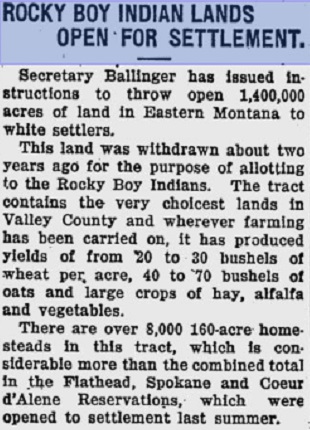
In 1908/1909, American leaders conspired to forcefully relocate chief Rocky Boy and his Ojibwa Subjects from their Reservation (they claim they were landless yet that's deceitful) which we don't know where it was located. It was obviously located at the Great Falls region. However, Fort Peck Reservation was most often advertised in news of those times as being chief Rocky Boys Ojibwa Reservation. That's incorrect. American leaders schemed to relocate chief Rocky Boys Ojibwa Subjects from their Reservation at the Great Falls region to other Reservations. One was Fort Pect Reservation. They advertised that chief Rocky Boy's 1909 Reservation was adjacent to Fort Peck Reservation and had a land area of 1.4 million acres. They made a blunder! They didn't bother covering it up! News article below is from the February 19, 1910 Kentucky New Era.
Fort Peck Reservation Land Act: On May 30, 1908 American leaders allotted 724,695.77 acres of land to 2,032 Ojibwa's. Average allotment size was close to 350 acres per individual. Then on July 25, 1913 American leaders opened the surplus land (it became surplus land in 1908 totaling 1,225,849 acres) to white settlement. Another 1,032.84 acres was used for white townsites. Brockton, Frazer, Poplar and Wolf Point are those white towns. On August 1, 1914, American leaders agreed to add land (126,054 acres) to the new smaller Fort Peck Reservation. Chief Rocky Boy and his sub-chiefs negotiated with American leaders during the winter of 1912/1913 at Helena, Montana about withdrawing Ojibwa Soldiers from the Mexican Revolution. In exchange Secretary of the Interior Lane, was instructed to secure land for chief Rocky Boys Ojibwa Subjects for many existing Ojibwa Reservations and creations of new Ojibwa Reservations. American leaders added 126,054 acres to the new smaller Fort Peck Reservation. Why leaders of Fort Peck Reservation continue to promote Fort Peck Reservation created by Sweetgrass Hills Treaty being as it was when it was created, don't make sense. However, they are employees of the government of the United States and don't care!
What you need to know concerning Fort Peck Reservation is it's reduction in size caused by May 30, 1908's Land Act which chief Rocky Boy took action for Fort Peck Reservation. Chief Rocky Boy agreed to allow land allotments as long as if they were in compact form and could not be sold. Remaining Fort Peck Reservation Land, after land allotments were distributed, was considered surplus land and was ceded to the United States. As written, surplus land had a total of 1,225,849 acres. It's no longer a part of Fort Peck Reservation. Chief Rocky Boy was against surplus land being ceded. However, his Ojibwa Subjects strongly suggested to chief Rocky Boy that they were in favor of accepting land allotments. Those land allotments and the 1914 land addition became the new smaller Fort Peck Reservation. American leaders don't want you knowing about that because they broke treaty agreements and allowed the land allotments to be sold. That was illegal. Those land allotments are today's Fort Peck Reservation. That is why we don't know where Fort Peck Reservation is! Ojibwa Prophesy tells Ojibwa's that white leaders will fool them. Those knowing about what happened in 1908/1909 pertaining to chief Rocky Boy, know this information is correct. American leaders made a blunder they could not conceal or they deliberately brought forth. They negotiated with chief Rocky Boy about Fort Peck Reservation and reached an agreement in which land allotments were approved and old Fort Buford Military Reservation was added to Fort Peck Reservation.
There are 5 Ojibwa communities at Fort Peck Reservation. Only one is not an enclave. That's Fort Kipp. Wolf Point continues to have a large white population. Wolf Point West Ojibwa Enclave is not within the city limits of Wolf Point. Wolf Point South Ojibwa Enclave is. However, Ojibwa's now make up the majority of Wolf Points population or 49% of Wolf Points population. Whites make up 29% of Wolf Points population. Poplar was predominantly white during the first half of the 20th century. Now it's predominantly Ojibwa. We can trace that to the 1909 forced relocation of chief Rocky Boys Ojibwa Subjects. Ojibwa's make up 71% of the population of Poplar. The two Ojibwa Enclaves near Poplar are not within the city limits of Poplar. Brockton was originally a white community. Now it's 96% Ojibwa. Frazer was obviously originally a white community. Frazer has much "Fee Land." Ojibwa's make up 97% of the population of Frazer.
Frazer: Located west of Wolf Point, Frazer is a small community north of Mississippi River (aka Missouri River) and east of Little Porcupine Creek. It was originally a white community. Ojibwa's have two enclaves at Frazer. Moccasin Ave to the south is land that is largely "Trust Land." On the west from Big Leggings Road south to Four Times Road is West Frazer Ojibwa Enclave. It's located on land that's all "Trust Land." On the east from Moccasin Ave south to Jackson Ave is East Frazer Ojibwa Enclave. It's also located on land that's all "Trust Land." North of Moccasin Ave is land that is largely "Fee Land."
Wolf Point: After Fort Peck Reservations surplus land was ceded, Ojibwa's established enclaves near Wolf Point. Their enclaves are located on land that is nearly all "Trust Land." Their locations at Wolf Point are Fairweather Street south to Knorr Street then 6th Ave South east to 2nd Ave Northeast. Further northwest their other enclave is located from Sunset Drive north to West Cascade Street then east to 6th Ave North. American leaders are not following agreements reached with chief Rocky Boy who refused to allow land allotments to be sold. Chief Rocky Boy allowed land allotments because he was told by American leaders that the land allotments in compact form that could not be sold, was the new reduced in size Fort Peck Reservation. He was again betrayed by American leaders who used trickery. American leaders are continuing to allow land allotments to be sold which is illegal.
Poplar: East of Wolf Point is Poplar. It's also located just north of Mississippi River (aka Missouri River) and also Poplar River. After Fort Peck Reservations surplus land was ceded, Ojibwa's established enclaves near Poplar. They're located east of Poplar from 3rd Ave South to Burlington Road then to 13th Ave East then north to Chokecherry Street where their largest enclave near Poplar is. Their Poplar Enclaves are located on land that is almost all "Trust Land."
Brockton: Brockton is located east of Poplar. Brockton was originally a white community with a larger population. It's almost adjacent to Mississippi River (aka Missouri River). Ojibwa's established an enclave slightly east of Brockton on "Trust Land." Location of the main Brockton Ojibwa Enclave is located along 1st Street south to Highway 2. From Badland Drive west to 4th Street is the smaller area of the Brockton Ojibwa Enclave. Only a small portion of the land is "Fee Land."
Wolf Point Satellite Image
Wolf Point West Ojibwa Enclave Satellite Image
Wolf Point West Ojibwa Enclave Road View
Wolf Point West Ojibwa Enclave Road View
Wolf Point West Ojibwa Enclave Road View
Wolf Point West Ojibwa Enclave Road View
Wolf Point West Ojibwa Enclave Road View
Wolf Point South Ojibwa Enclave Satellite Image
Wolf Point South Ojibwa Enclave Road View
Wolf Point South Ojibwa Enclave Road View
Wolf Point South Ojibwa Enclave Road View
Wolf Point South Ojibwa Enclave Road View
Wolf Point South Ojibwa Enclave Road View
Poplar Satellite Image
Poplar North Ojibwa Enclave Satellite Image
Poplar North Ojibwa Enclave Road View
Poplar North Ojibwa Enclave Road View
Poplar North Ojibwa Enclave Road View
Poplar North Ojibwa Enclave Road View
Poplar North Ojibwa Enclave Road View
Poplar North Ojibwa Enclave Road View
Poplar North Ojibwa Enclave Road View
Poplar North Ojibwa Enclave Road View
Poplar North Ojibwa Enclave Road View
Poplar North Ojibwa Enclave Road View
Poplar North Ojibwa Enclave Road View
Poplar North Ojibwa Enclave Road View
Poplar North Ojibwa Enclave Road View
Poplar North Ojibwa Enclave Road View
Poplar South Ojibwa Enclave Satellite Image
Poplar South Ojibwa Enclave Road View
Poplar South Ojibwa Enclave Road View
Poplar South Ojibwa Enclave Road View
Poplar South Ojibwa Enclave Road View
Poplar South Ojibwa Enclave Road View
Poplar South Ojibwa Enclave Road View
Poplar South Ojibwa Enclave Road View
Poplar South Ojibwa Enclave Road View
Poplar South Ojibwa Enclave Road View
Poplar South Ojibwa Enclave Road View
Poplar South Ojibwa Enclave Road View
Poplar South Ojibwa Enclave Road View
Poplar South Ojibwa Enclave Road View
Poplar South Ojibwa Enclave Road View
Poplar South Ojibwa Enclave Road View
Brockton Satellite Image
Brockton Road View
Brockton Road View
Brockton Road View
Brockton Road View
Brockton Road View
Brockton Road View
Brockton Road View
Brockton Road View
Frazer Satellite Image
Frazer East Ojibwa Enclave Satellite Image
Road View
Road View
Road View
Road View
Road View
Frazer West Ojibwa Enclave Satellite Image
Road View
Road View
Road View
Road View
Road View
Road View
Fort Kipp Satellite Image
Fort Kipp Road View
Fort Kipp Road View
Fort Kipp Road View
Fort Kipp Road View
Fort Kipp Road View
Fort Kipp Road View
Fort Kipp Road View
Fort Kipp Road View


Demographics of Fort Peck Reservation
Land Area: 850,749.77 acres or 1,329.3 sq. mi. - 344,286.2 hectares or 3,442.8 sq. km.
Population: 6,066 - (2024 estimate - including Mexicans and mixed bloods it's 7,143)
Language: Corrupted
