Ojibwa AI Videos ___ Walmart ___ Amazon
Ojibwa Prophesy ____ Ebay ______ TV Playlists
Montana Ojibwe Reservations and their Communities Book
Minnesota Ojibwe Reservations and their Communities Book
Place Names of the Ojibwa in Future Codes Book

Anishinabe History
Ojibwa AI Videos ___ Walmart ___ Amazon
Ojibwa Prophesy ____ Ebay ______ TV Playlists
Montana Ojibwe Reservations and their Communities Book
Minnesota Ojibwe Reservations and their Communities Book
Place Names of the Ojibwa in Future Codes Book
Blackfeet Reservation
On October 17, 1855, Judith River Treaty established Blackfeet Reservation. Below are demographics (population), maps of Blackfeet Reservation and links to google earth photos of Browning. All Blackfeet Reservation towns are located at it's west portion, except Little Browning (aka Seville). Blackfoot town is about 6 miles east of Browning town. Browning is situated between North Browning and South Browning. Both North Browning and South Browning are Ojibwa Enclaves. Seville (aka Little Browning) is an Ojibwa Enclave near Cut Bank, Montana. Another Ojibwa Enclave is located at Babb and another at East Glacier Park Village. Most of Browning is located on "Fee Land." Many businesses are located at Browning. Most are probably owned by whites. Browning may have been a white community originally. Blackfeet Reservation history and language is very complicated and involved use of deception (trickery). Blackfeet Language is really Ojibwa Language white leaders corrupted.
Blackfeet Reservation has not been opened to white settlement. May 1, 1888's Blackfeet Reservation had a land area of 1.76 million acres or 712,246.7 hectares or 2,750 sq. mi. or 7,122.5 sq. km. It stayed that way until 1895. American leaders were already conspiring to forcefully relocate 1,000's of Ojibwa People living throughout their vast Montana Reservation located where land area number 399 is on the map provided. Reservation Blackfeet history involves 4 large land areas created to be Blackfeet Reservation by October 17, 1855's Treaty. Those land area numbers are 398, 399, 565 and 574. Land area numbers 398 and 399 were never ceded. Ojibwa leaders signed October 17, 1855's Treaty allowing Americans to establish mining camps throughout land area number 398. Those mining camps were to be left after 99 years. American leaders used deception (trickery) and by 1865 had commenced converting the mining camps to towns. That greatly intensified long Mullan Road War as did Sun River Stampede of 1865/1866. Isaac Stevens negotiated several treaties before October 17, 1855's Treaty including July 16, 1855's Treaty. Each of the Isaac Stevens Treaties were ratified by October 17, 1855's Treaty.
Concerning 1895's Blackfeet Reservation land cession which ceded over 800,000 acres (nearly a third of Blackfeet Reservation), Ojibwa leaders possibly knew about it and possibly some commenced to follow prophesy and migrate west and north. In late spring and early summer 1896, American Soldiers and Ojibwa Traitors Soldiers led by Little Bear, commenced to round up 1,000's of Ojibwa People living at and near Great Falls, to forcefully relocate them to other Reservations and also to Canada. One Reservation they sent them to was Blackfeet Reservation created on May 1, 1888. Another was Fort Belknap Reservation also created on May 1, 1888. In January of 1895, American Representatives commenced to negotiate with Ojibwa leaders of Blackfeet Reservation created on May 1, 1888, about a land cession. Their attitude was positive and greed motivated them. Informed ceded portion of Blackfeet Reservation was for chief Rocky Boys Ojibwa Subjects from the region from Highwood Mountains west to Rocky Mountains and south to near Helena, did not trouble them. Land to be ceded was not intended for mining. It was intended for 100's of Ojibwa People American leaders were planning to forcefully relocate to Blackfeet Reservation created on May 1, 1888. Bribery was used by American leaders which Ojibwa leaders took advantage of. They (Ojibwa leaders of Blackfeet Reservation created on May 1, 1888) first demanded $3 million (it's proof they willingly accepted the bribe) yet they were in touch with American intentions. American Representatives refused their offer. An offer of $1.5 million was suggested by American Representatives and it was accepted.
Blackfeet Reservation's (created on May 1, 1888) west portion was selected to relocate 100's of Ojibwa's from the land region that is within land are number 399. Other locations were negotiated yet the west portion was unanimously accepted. In May and June of 1896 (they ratified 1895's Blackfeet Reservation land cession on June 10, 1896), American Soldiers and Ojibwa Traitors Soldiers led by Little Bear, rounded up 1,000's of Ojibwa People near Great Falls. They then commenced to board them on train boxcars to be relocated elsewhere. An Ojibwa leader at Great Falls was enraged about what was happening. He was possibly chief Rocky Boy. An August 7, 1896 Great Falls Tribune news article describes 500 people waiting at Blackfeet Reservations border, waiting to settle at Blackfeet Reservation land cession land. Below are excerpts from that August 7, 1896's Great Falls Tribune news article. Carefully read paragraph 5 pertaining to "This Section Will Be Tributary Almost Entirely To Great Falls and paragraph 4 above paragraph 5." Those 500 people were Ojibwa People from Great Falls. Many Ojibwa People living at Blackfeet Reservation, are continuing to cling to their Ojibwa Nationality. Reservation leaders will not recognize them out of fear of prophesy. They know chief Rocky Boy is very important to Blackfeet Reservation created on May 1, 1888 and June 10, 1896. They also know about chief Rocky Boy and 100's of his Ojibwa Subjects being forced to relocate to Blackfeet Reservation created on June 10, 1896, in November of 1909. Chief Rocky Boy and 600 or more of his Ojibwa Subjects who were forced to reach chief Rocky Boys camp near Fort Harrison near Helena (no other American Forts at north central Montana had enough soldiers to guard them), reached Browning and other Reservations and Reserves on November 14, 1909 and after. After reaching Browning chief Rocky Boy made himself at home at Blackfeet Reservation.
Blackfeet Reservation Land Allotment Act: Chief Rocky Boy agreed to allow land allotments (we don't know when he approved yet it was before 1907 | chief Rocky Boy was acquainted with Blackfeet Reservation as early as the 1880's) as long as if they were in compact form and could not be sold. On March 1, 1907, Blackfeet Reservation Land Allotment Act distributed 886,979 acres to 2,656 Ojibwa's. American leaders used trickery again and allowed the land allotments to be sold. That's why Blackfeet Reservation has a large white population. All those land allotments belong to Blackfeet Reservation. No surplus land was available after land allotments were distributed. American leaders set aside 44,240.07 acres as timber reserved land. A map of 1895's land cession to chief Rocky Boys Ojibwa Subjects is below. At it's extreme northwest is the extreme southwest boundary of Alberta. Glacier County's west boundary is the west boundary of 1895's land cession to chief Rocky Boys Ojibwa Subjects. East boundary is what is considered todat's west boundary of Blackfeet Reservation. 1895's land cession was ceded to Ojibwa's from the Great Falls region and remains a part of Blackfeet Reservation. You'll notice east portion of Blackfeet Reservation has extensive farm land. I suspect Blackfeet Reservations east was ceded in 1895 and the west portion of Blackfeet Reservation extends to the west boundary of Glacier National Park. Read the news article very carefully. It reads "The Agriculture Lands." Blackfeet Reservations 1895's ceded portion has almost no agriculture land.
North Browning and South Browning Ojibwa Enclaves: Competition between Blackfoot and Browning for a Railroad Station went to Browning. Blackfoot received a Railroad Stop. Where Browning is, many land allotments were sold as a result of a belief the land was good agriculture land. That proved wrong! I don't know how many whites illegally bought land allotments where Browning is. It's probable dozens of whites illegally bought land allotments where Browning is and settled there. Since farming was difficult some established businesses. North Browning is located on "Trust Land." South Browning is located mostly on "Trust Land." Browning is largely located on "Fee Land." Since 1896, large numbers of Ojibwa's had been forced to relocate to Blackfeet Reservation. 1909's forced relocation brought over 100 of chief Rocky Boys Ojibwa Subjects to Browning. More arrived in 1910 and possibly up to 1912. After reaching Browning they established Ojibwa Enclaves north of Browning and south of Browning. Since Browning including North Browning and South Browning has a population of over 5,000, it's very likely historians were dishonest about how many Ojibwa's were forced to relocate to Blackfeet Reservation.
Heart Butte Ojibwa Enclave: An isolated Blackfeet Reservation community, Heart Butte is located at the southwest portion of Blackfeet Reservation. There are two distinct portions of Heart Butte. A North Heart Butte and a South Heart Butte. Both communities are separated by about 1/2 a mile. It's confirmation that there is an Ojibwa Enclave located at Heart Butte. It's North Heart Butte. Streets located at North Heart Butte include Skunk Town Road and Skunk Village Road. Ojibwa word for skunk is supposedly "Zhi-Kag." Pronunciation is Shi-kog. Will name North Heart Butte "Shi-kog O-de-na." Translation is Skunk Town. Actually Baraga did not include "Skunk" in his 19th century Otchipwe Language Dictionary. His inclusion of "Polecat" also represents both "Ferret and Skunk." However, Baraga did not include ferret and skunk in his 19th century Otchipwe Language Dictionary. He wrote the Ojibwa word for Polecate French style. It's "Ji-kag." You might suspect "ji" is pronounced like the letter "g." It isn't. It's pronounced "Zhi." Chicago is derived from the Ojibwa word "Zhi-kag." However, it's correct pronunciation is "Shi-ka-goag." Whites usely changed the Ojibwa "g" plural to a "k." However, instead of using either the "g or K," they pronounced it "Shi-ka-go." Definition of "Shi-ka-goag" is "Polecate People." Ojibwa's had villages at mountain valleys southwest of Heart Butte. American leaders forced them to relocate to the Heart Butte region. One of their mountain valley villages was named "Little Chicago." Ojibwa's pronounce it "Shi-ka-go-ges." Chicago Little!
Little Browning Ojibwa Enclave: After a Railroad Station was established at Cut Bank, a community commenced to expand around the Railroad Station. According to historians, during a severe snow storm accompanied by very cold temperatures, a young Chippewa girl was found outside the Cut Bank Newspaper building at Cut Bank in serious condition. She was brought into the building to save her from freezing to death. An employee of the Cut Bank Newspaper was instructed to go by horse to the nearby Chippewa Camp to find her family. While the employee was away the young Ojibwa Girl awoke and tried to escape. However, an employee of the Cut Bank Newspaper was quick to prevent her from leaving which, if she had made her escape, would have led to her freezing to death. Within time the Cut Bank Newspaper Employee who went to the nearby Chippewa Camp, returned with severval Ojibwa Men from the Ojibwa Camp. She was immediately recognized by them as being from the Rocky Boy Ojibwa's. They took the young Ojibwa Girl and mounted their horses and quickly made for their village which is now Little Browning (aka Seville). The incident took place before 1910. Little Browning is an Ojibwa Enclave located very near Cut Bank. Cut Bank Creek flows between the communities.
East Glacier Park Village Ojibwa Enclave Before it was known as East Glacier Park Village this Blackfeet Reservation community was known as Midvale. It obtained it's name after a Railroad Stop was established there. After Glacier National Park was illegally established in 1910, white entrepreneurs became attracted to Midvale and the expected wealth the location would generate. Land allotments were bought illegally and Midvale commenced to become a community. Not long after Glacier National Park was illegally established, they changed the name of Midvale to East Glacier. Today it's known as East Glacier Park Village. Ojibwa's have been living at the location for 1,000's of years. Between Flathead River and Marias River (aka Two Medicine Creek) were creeks Ojibwa's expanded into one waterway by creating reservoirs. Reason for establishing the creeks into one waterway was salmon. From Pacific Ocean the salmon swam to Flathead River then to the waterway Ojibwa's created between Flathead River and Marias River. Of course, the waterway created by Ojibwa's allowed salmon to swim to north central Montana including to the Great Falls region. An Ojibwa Enclave was established near East Glacier Park Village on "Trust Land." It's location is the east portion of southeast East Glacier Park Village.
Babb Chief Rocky Boy possibly used the Babb region to return to his native Montana in June or July 1885 (he was 34 years old at the time) or shortly after 1885's Northwest Rebellion. He obviously took to the Babb region yet his intentions involved returning to his home at or near Great Falls. During the 1909 forced relocations of Ojibwa's, many selected the Babb region to settle at. After Glacier National Park was illegally established in 1910, chief Rocky Boy's Ojibwa Subjects established an Ojibwa Enclave where Babb is located. White entrepreneurs were attracted to Babb to establish businesses. This Ojibwa Enclave has never had a large population. At Blackfeet Reservation it's also known as "Paahtomaksikimi." I don't know the translation!
Starr School: During early 1912, Ojibwa's from Blackfeet Reservation were invited to the Helena region to negotiate. American leaders were enraged and frustrated with chief Rocky Boy. Mexico's vicious war was intensifying and they needed chief Rocky Boy to bring Ojibwa Soldiers out of the conflict. Of course, chief Rocky Boy and his sub-chiefs could have refused to negotiate. However, they wanted their Reservation at the Great Falls and Helena regions restored, new Ojibwa Reservations created and land stolen from many other Reservations restored. Though newspapers wrote that the 400 Ojibwa's from Blackfeet Reservation reached the Helena region in autumn 1911 that's probably a mistake. Some Ojibwa leaders from Blackfeet Reservation were probably instructed by chief Rocky Boy to visit the Helena region to inquire about the obvious request they received in late 1911. After being informed of what American leaders were requesting, they made for Blackfeet Reservation to inform chief Rocky Boy that American leaders needed his support. Supposedly chief "Full of Dew" was in charge of the 400 Ojibwa's at the Helena region in January 1912. Either the 400 Ojibwa's did reach the Helena region in October 1911 or deception was used by reporters. According to the January 1912 news article, chief Full of Dew had demands if the 400 Ojibwa's and himself were to return to Blackfeet Reservation. Negotiations to withdraw Ojibwa Soldiers from Mexico's vicious war probably commenced in January 1912. Chief Full of Dew told American leaders they'd be willing as long as if rations were provided, they were not forced to adopt the European religions, they could grow their hair long and that their children would be sent to a "School" close enough to the colony so they could return each night to their fathers. It was the first attempt at negotiating a restoration of the large Ojibwa Reservation at the Great Falls and Helena region and possibly recognition of an Ojibwa Reservation at Blackfeet Reservation. We know where it's located. Their main community is Starr School. Obviously American leaders had difficulties during the negotiations because the negotiations continued into 1913. From reports provided by newspapers, the colony at Blackfeet Reservation is either 2 townships, 3 townships or 133 sq. mi. or all of Blackfeet Reservation. Chief Rocky Boy did demand an Ojibwa Reservation at Blackfeet Reservation because he was only too aware that Ojibwa Children were being brainwashed at Blackfeet Reservation Schools. During August 1913, negotiations had reached completion. Mexico's vicious war commenced to diminish because chief Rocky Boy did withdraw Ojibwa Soldiers from that conflict. By late August 1913 chief Rocky Boy and near 40 other Ojibwa's from Blackfeet Reservation, reached the Great Falls region and established an Ojibwa village west of Great Falls. It was probably located near Ulm. However, chief Rocky Boy continued his control over his Ojibwa Subjects at Blackfeet Reservation also.
Blackfoot: As written earlier, Blackfoot and Browning were in competetion for a Railroad Station. Browning won and became the dominant Blackfeet Reservation community. However, Blackfoot became a Railroad Stop. Not as important as a Railroad Station, the Railroad Stop at Blackfoot did create a small Blackfeet Reservation community. I don't know much about Blackfoot and the history of the community. Blackfoot probably had a larger population than now during the early and mid 20th century. If an Ojibwa Enclave was located near Blackfoot I'm not aware of that enclave.
Browning Satellite Image
North Browning Ojibwa Enclave Road View
North Browning Ojibwa Enclave Road View
North Browning Ojibwa Enclave Road View
North Browning Ojibwa Enclave Road View
North Browning Ojibwa Enclave Road View
North Browning Ojibwa Enclave Road View
North Browning Ojibwa Enclave Road View
North Browning Ojibwa Enclave Road View
South Browning Ojibwa Enclave Road View
South Browning Ojibwa Enclave Road View
South Browning Ojibwa Enclave Road View
South Browning Ojibwa Enclave Road View
South Browning Ojibwa Enclave Road View
South Browning Ojibwa Enclave Road View
South Browning Ojibwa Enclave Road View
South Browning Ojibwa Enclave Road View
South Browning Ojibwa Enclave Road View
Heart Butte Satellite Image
Little Browning Ojibwa Enclave Satellite Image
Little Browning Ojibwa Enclave Road View
Little Browning Ojibwa Enclave Road View
Little Browning Ojibwa Enclave Road View
Little Browning Ojibwa Enclave Road View
Little Browning Ojibwa Enclave Road View
Little Browning Ojibwa Enclave Road View
Little Browning Ojibwa Enclave Road View
Little Browning Ojibwa Enclave Road View
Little Browning Ojibwa Enclave Road View
Little Browning Ojibwa Enclave Road View
East Glacier Park Village Ojibwa Enclave Satellite Image
East Glacier Park Village Southeast Ojibwa Enclave Satellite Image
East Glacier Park Village Ojibwa Enclave Road View
East Glacier Park Village Ojibwa Enclave Road View
East Glacier Park Village Ojibwa Enclave Road View
East Glacier Park Village Ojibwa Enclave Road View
East Glacier Park Village Ojibwa Enclave Road View
East Glacier Park Village Ojibwa Enclave Road View
East Glacier Park Village Ojibwa Enclave Road View
East Glacier Park Village Ojibwa Enclave Road View
Babb Ojibwa Enclave Satellite Image
Babb Ojibwa Enclave Road View
Babb Ojibwa Enclave Road View
Babb Ojibwa Enclave Road View
Babb Ojibwa Enclave Road View
Babb Ojibwa Enclave Road View
Babb Ojibwa Enclave Road View
Babb Ojibwa Enclave Road View
Babb Ojibwa Enclave Road View
Babb Ojibwa Enclave Road View
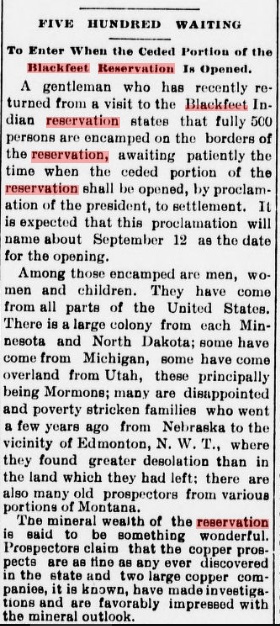
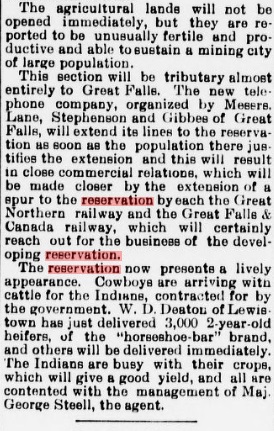

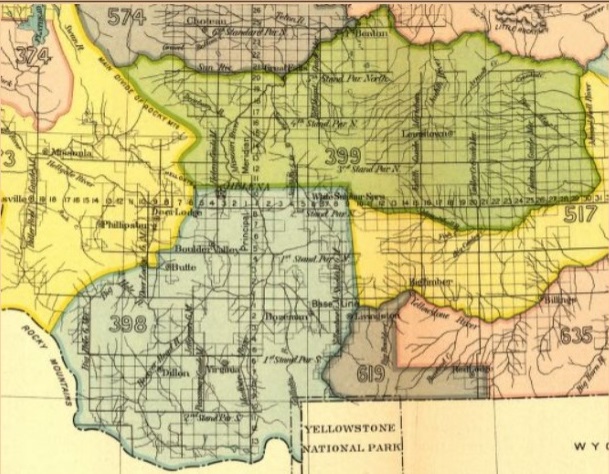
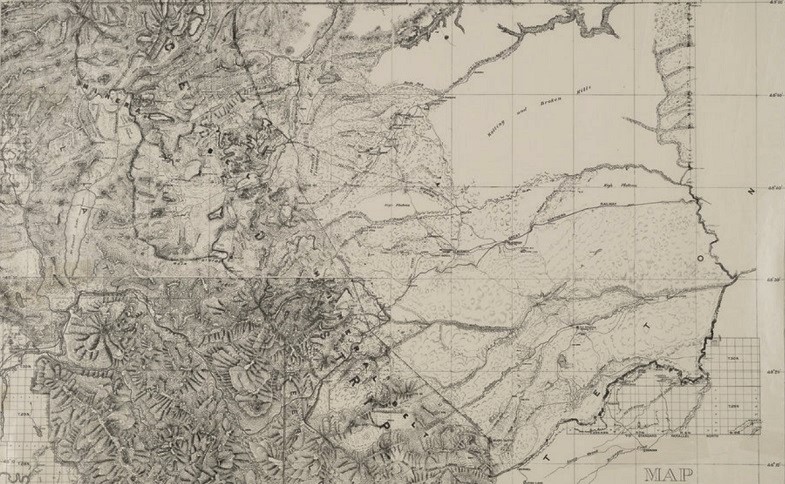
1896 map of 1895's land cession to chief Rocky Boys Ojibwa Subjects. Entire west portion is now the west boundary of Glacier County. Chief Rocky Boy and his Ojibwa Subjects did not want to relocate. Colonel Pershing and his American Soldiers and Little Bear and his Ojibwa Traitors Soldiers forcefully rounded up 1,000's of chief Rocky Boys Ojibwa Subjects during May, June and July 1896. On June 10, 1896, American leaders approved of Blackfeet Reservations 1895's land cession and other Reservations land cessions to chief Rocky Boys Ojibwa Subjects. On June 7, 1896, another land cession was approved by American leaders. It was Wind River Reservations land cession to chief Rocky Boys Ojibwa Subjects. On June 7, 1897, American leaders approved of Uncompahgre Reservation being ceded to chief Rocky Boys Ojibwa Subjects. Chief Rocky Boy probably considered June 10 a national Ojibwa Holiday. According to a 1901 news article, chief Rocky Boy and his Ojibwa Subjects held festivities on either June 10, 1901 or June 11, 1901. Soon after, chief Rocky Boy led 100's of his Ojibwa Subjects to a large area of Fort Hall Reservation ceded to them. In 1900, chief Rocky Boy led 100's of his Ojibwa Subjects to Crow Reservations north portion ceded to them on June 10, 1896. After leaving Fort Hall Reservation in late summer 1901, chief Rocky Boy made for his home near Great Falls, Montana. In 1903, chief Rocky Boy led many of his Ojibwa Subjects to Blackfeet Reservation. He then returned to his home near Great Falls. Of course, chief Rocky Boy led them to 1895's land cession at Blackfeet Reservation. He also led his Ojibwa Subjects to Northern Cheyenne Reservations 1900 land addition and Navajo Reservations 1900 land addition.
Demographics of Blackfeet Reservation
Land Area: 3,535.4 sq. mi. or 9,156.6 sq. km. (includes 1895's land cession to chief Rocky Boys Ojibwa Subjects)
Population: 10,764 (2020 census)
Ojibwa: 9,058
White: 1,195
Mixed Bloods: 461
Mexican: 207
Asian: 14
Black: 10
Language: Corrupted
